



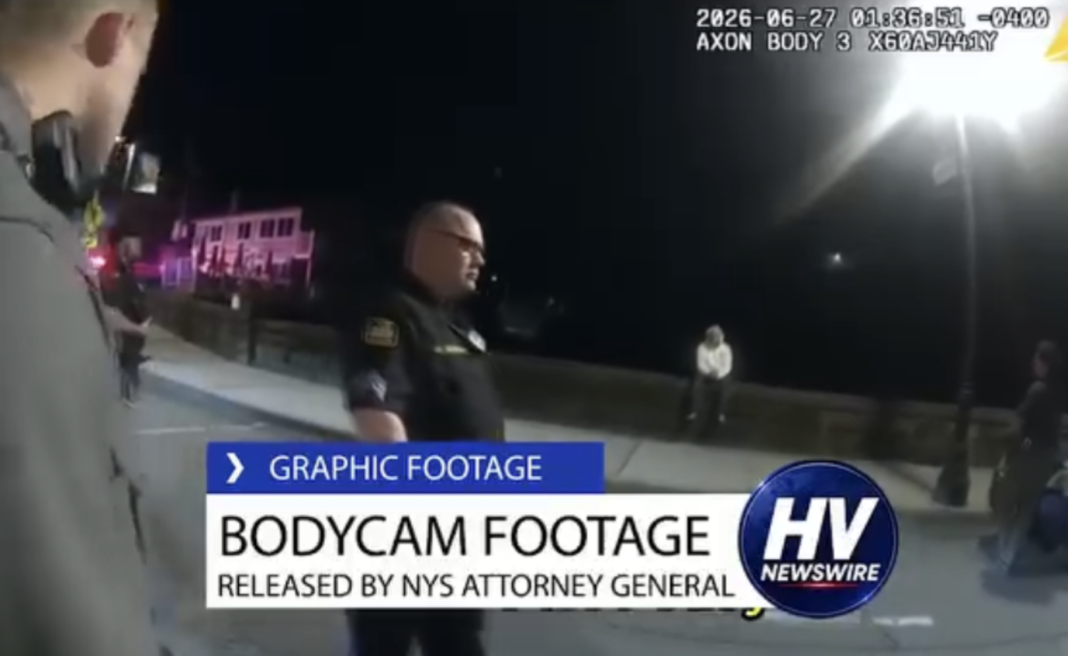
WAPPINGERS FALLS— The New York State Attorney General Office has released body-worn camera footage showing a fatal police shooting of a minor in Dutchess County earlier this summer.
The release is part of an ongoing investigation by the Attorney General’s Office of Special Investigation (OSI) into the June 27 death of the youth, identified by officials as O.C.
According to the attorney general’s office, officers from the New York State Police, the Dutchess County Sheriff’s Office, and the Village of Village of Wappingers Falls Police Department responded in the early morning hours of June 27 to a 911 call reporting a suicidal person in Wappingers Falls.

Upon arrival, officers encountered the teenager on the ledge of an overpass bridge holding a knife. Authorities said officers attempted to negotiate with the youth for approximately 50 minutes.
The minor then stood up and allegedly ran toward at least one officer while armed with the knife. Multiple officers fired their service weapons, striking the youth.
The teenager was transported to a local hospital, where he was pronounced dead. Investigators recovered a knife at the scene.
Attorney General Letitia James released the video footage in accordance with a state directive aimed at increasing transparency and public trust during investigations into officer-involved deaths. Under New York law, the OSI evaluates every incident in which a police officer may have caused a person’s death.
Officials emphasized that the public release of the footage does not reflect an opinion on criminal liability or indicate whether any charges will be filed. It is also difficult to determine the level of threat police officers felt as the teen moved toward them.
Mental Health Advocacy and Legislative Push:
The tragic incident in Dutchess County highlights broader statewide debates over how emergency services handle mental health calls.
Civil rights advocates, including the New York Civil Liberties Union (NYCLU), have pointed to such incidents as evidence of the need to pass “Daniel’s Law” (S.3670 / A.4617), proposed legislation that would fundamentally shift how New York State responds to behavioral health crises.
Named in honor of Daniel Prude—a Black man who died in 2020 after being physically restrained by Rochester police officers while experiencing a mental health episode—the proposed legislation aims to remove law enforcement as default first responders for individuals experiencing mental health or substance use emergencies.
The NYCLU supports Daniel’s Law because it would:
Promote a Public Health Response: Treat behavioral health emergencies as public health issues rather than public safety threats.
Deploy Specialized Crisis Teams: Mandate that mobile crisis teams composed of mental health professionals and peers—individuals with lived mental health or substance use experience—respond to crisis calls without law enforcement accompaniment, unless special circumstances involve immediate physical danger.
Reduce Police Violence: Address data indicating that people experiencing mental health crises are disproportionately vulnerable to police force and fatal encounters.
Despite strong support from criminal justice reformers and mental health advocacy organizations, Daniel’s Law remains stalled in the New York State Legislature. Key factors contributing to the legislative delay include:
Task Force Evaluation: Lawmakers established the statewide Daniel’s Law Task Force under the New York State Office of Mental Health to study crisis models, hold public stakeholder sessions, and evaluate operational feasibility and funding sources before enacting major structural changes.
Funding and Logistics: Critics and state officials have cited concerns over the significant financial resources and specialized workforce needed to establish 24/7 non-police crisis response teams across rural, suburban, and urban communities statewide.
Pushback from Law Enforcement and Local Officials: Some police organizations and municipal leaders argue that removing law enforcement from potentially dangerous or unpredictable crisis scenes could pose safety risks to civilian responders and the public.